
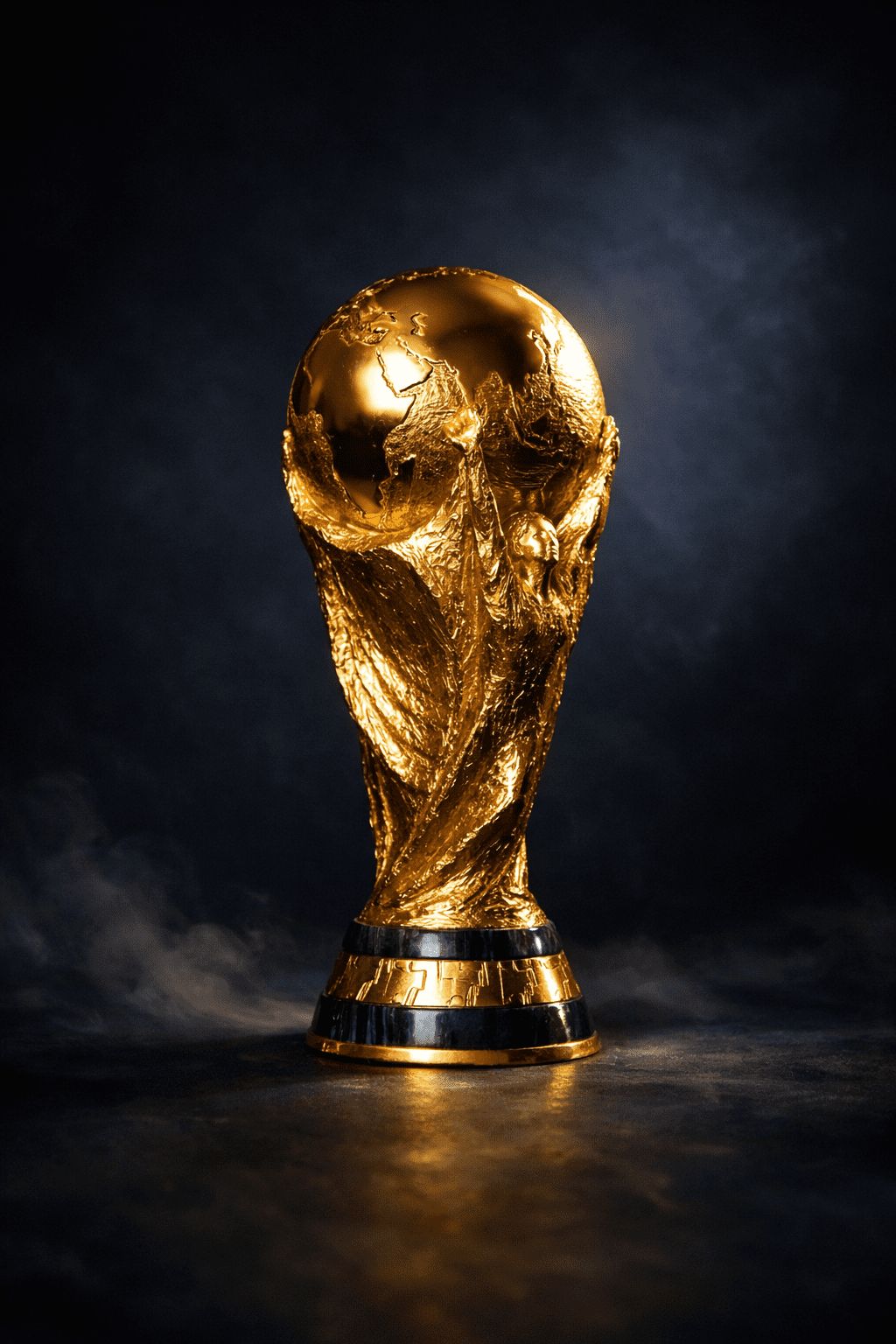
World Cup 2026: The Complete Guide
Every four years, football takes over the world. From June 11 to July 19 2026, the biggest sporting event on the planet comes to North America for the first time in 32 years. There are 48 nations, 16 stunning stadiums, three host countries and one golden trophy. This is your complete guide to the 2026 FIFA World Cup. Whether you are a lifelong football fan or someone who watches once every four years, this is the place to start.

The 2026 FIFA World Cup: 48 teams, 16 cities, one trophy. Here is everything you need to know.
The Basics: What, Where and When
The 2026 FIFA World Cup is the 23rd edition of the tournament and by far the biggest in history. For the first time ever, 48 nations will compete instead of the usual 32. That means more matches, more stories and more chances for the underdog to cause a shock. The tournament runs from 11 June to 19 July 2026, spanning 39 days and 104 matches across three countries.
The three host nations are the United States, Canada and Mexico. This is the first World Cup ever to be shared between three countries, and the first time North America has hosted since 1994, when the USA put on a brilliant tournament that helped plant football’s seeds across the continent. Canada hosts a World Cup for the very first time. Mexico, remarkably, hosts for the third time, having welcomed both Pele in 1970 and Diego Maradona in 1986.
The opening match kicks off on 11 June at the Estadio Azteca in Mexico City, where Mexico face South Africa. The final is on 19 July at MetLife Stadium in East Rutherford, New Jersey, just outside New York City. Coldplay will perform at half-time of the final. Not a bad way to close out the biggest sporting event on earth.
The Three Host Nations: A Quick Geography Lesson
Understanding where the matches are being played makes the whole tournament feel more real. The 16 host cities span an enormous geographical area, so FIFA divided them into three regions to keep travel manageable for teams and fans.
In Mexico, matches are played in Mexico City, Guadalajara and Monterrey. Mexico City is one of the largest cities on earth with a population of around 22 million people. It sits at an altitude of 2,240 metres above sea level, which has historically caused problems for visiting teams whose players are not acclimatised to playing at height. The Estadio Azteca, which hosts the opening match, has a capacity of around 83,000 and is the only stadium in the world to have hosted two World Cup finals, in 1970 and 1986. Walking onto that pitch is walking into history.
In Canada, matches are hosted in Toronto and Vancouver. Toronto is Canada’s largest city, a multicultural metropolis on the northwestern shore of Lake Ontario with a population of around 6 million. Vancouver sits on the Pacific coast of British Columbia, surrounded by mountains, and is consistently ranked among the most beautiful cities in the world. BC Place, the stadium there, hosted the closing ceremony of the 2010 Winter Olympics. Both cities are hosting the World Cup for the first time.
In the United States, eleven cities are involved: Atlanta, Boston, Dallas, Houston, Kansas City, Los Angeles, Miami, New York/New Jersey, Philadelphia, San Francisco and Seattle. The distances involved are extraordinary. Los Angeles to Miami is roughly the same distance as London to Baghdad. This is football on a continental scale.
The Stadiums: Cathedrals of American Sport
Most of the North American stadiums were built for American football, which means they are enormous, futuristic and unlike anything European fans are used to. The AT&T Stadium in Dallas, known locally as “The Death Star,” can hold up to 105,000 people and is the largest stadium at this World Cup. The SoFi Stadium in Los Angeles, home of the LA Rams and Chargers, cost five billion dollars to build and is considered the most expensive stadium ever constructed. It has a video ring that hangs from the roof and displays content in 360 degrees around the entire venue.
Then there is Arrowhead Stadium in Kansas City, home of the NFL’s Kansas City Chiefs and officially the loudest outdoor sports venue in the world according to the Guinness World Records. The MetLife Stadium in New Jersey, which hosts the final, held the Super Bowl in 2014 despite being open-air in winter, which tells you something about the toughness of NFL fans. The Estadio Azteca in Mexico City is the oldest venue in the tournament, opened in 1966 and still one of the most atmospheric stadiums on earth.
The Format: Bigger, Bolder and More Dramatic Than Ever
The expansion from 32 to 48 teams changes how the tournament works in a few important ways. Instead of eight groups of four, there are now twelve groups of four. The top two teams from each group advance automatically, and then the eight best third-placed teams across all twelve groups also go through. That means 32 teams make it out of the group stage and into a new round called the Round of 32, an extra knockout round that did not exist before.
This matters because it reduces the number of dead rubbers in the group stage and gives more teams a genuine chance of going deep into the tournament. A nation like Norway or Scotland or Senegal who might have gone home at the group stage in previous formats now has a much better chance of reaching the knockout rounds. More drama, more stories, more of the moments that make the World Cup the greatest sporting event in the world.
The total number of matches jumps from 64 at previous tournaments to 104 in 2026. Teams that reach the final will play eight matches in total, one more than before. It is the most football ever played at a single World Cup.
The 48 Nations: A Snapshot of the World
One of the great joys of the expanded World Cup is the sheer variety of nations involved. This is not just a tournament for Europe and South America. Here is a quick flavour of who is coming and what makes them interesting.
Four nations are appearing at a World Cup for the very first time: Cape Verde, Curacao, Jordan and Uzbekistan. Curacao, a small Caribbean island with a population of around 160,000, is the smallest nation by population ever to qualify for a World Cup. The entire country could fit comfortably into a mid-sized European city. Jordan, whose capital is Amman, qualified as part of a brilliant run of results in Asian qualifying and will face Argentina and Austria in Group J. Uzbekistan, whose capital Tashkent sits in Central Asia between Kazakhstan and Tajikistan, defeated some strong opponents to reach their first ever tournament.
Iraq return to the World Cup for the first time since 1986, a 40-year absence that ended with a dramatic playoff victory over Bolivia. The last time Iraq played at a World Cup, Diego Maradona was at his peak and the Berlin Wall still stood. Bosnia and Herzegovina reach their second ever World Cup and they did it in the most dramatic fashion possible, beating Italy on penalties in the playoff final. Italy, one of the most decorated nations in football history with four World Cup titles, miss the tournament for the third consecutive time. That has never happened to Italy before.
Norway arrive at their first World Cup since 1998 and bring with them Erling Haaland, widely considered one of the two or three best players in the world. Scotland return for the first time since 1998. Morocco, who reached the semi-finals at the 2022 World Cup in Qatar, come as genuine dark horses. Senegal bring a squad packed with Premier League talent. The variety of stories across 48 nations is unlike anything the tournament has produced before.
The Groups at a Glance
Here are all twelve groups for the 2026 World Cup. Each group plays out across June, with the top two teams and eight best third-placed sides advancing to the knockout stage.
Group A features Mexico, South Korea, South Africa and Czechia, with Mexico hosting the opening match at the Azteca. Group B has Canada, Bosnia and Herzegovina, Qatar and Switzerland. Group C is Brazil, Morocco, Scotland and Haiti. Group D brings together the United States, Paraguay, Australia and Turkiye. Group E is Germany, Ivory Coast, Ecuador and Curacao. Group F pairs Netherlands, Japan, Tunisia and Sweden in what could be one of the most evenly matched groups of the tournament.
Group G has Belgium, Egypt, Iran and New Zealand. Group H features Spain, Uruguay, Saudi Arabia and Cape Verde. Group I is widely seen as the toughest group, with France, Senegal, Norway and Iraq all capable of producing brilliant football and shocking results. Group J is Argentina, Algeria, Austria and Jordan. Group K has Portugal, Colombia, DR Congo and Uzbekistan. Group L rounds things off with England, Croatia, Ghana and Panama, a group where England will feel heavy pressure to deliver after years of near misses.
The Ones to Watch: Five Players Who Could Define the Tournament
Every World Cup has its defining player. Brazil 1970 had Pele. Argentina 1986 had Maradona. France 1998 had Zidane. Here are five players who could write themselves into that conversation in 2026.
Erling Haaland of Norway is perhaps the most exciting prospect. The Manchester City striker is a physical phenomenon, capable of scoring in every conceivable way. Norway have never lost a World Cup match they have completed at full strength, and with Haaland leading the line against France and Senegal in Group I, they have a genuine chance of causing a major upset. Lamine Yamal of Spain is 18 years old and already considered one of the most gifted players of his generation. The Barcelona winger has a low centre of gravity, an extraordinary first touch and the kind of fearlessness that only teenagers possess. Vinicius Junior of Brazil will be playing his first World Cup in front of the whole world and desperate to prove that the best individual player in club football can also be the best player at international level. Jude Bellingham of England carries the weight of a nation on his shoulders but has shown repeatedly that he thrives under pressure. And Lionel Messi, the defending champion, the greatest player who has ever lived, arrives at what is almost certainly his final World Cup seeking to add one more chapter to the most remarkable career in football history.
Everything We Will Be Covering
Here at Explored Football, the World Cup 2026 is going to be the centrepiece of our summer. We will be covering every group in detail with previews and analysis. We will profile the most fascinating nations and the stories behind them. We will dig into the fun facts, the geography, the history and the football. And when the matches start, we will be here with reaction and analysis after every major result.
This page is your hub. Bookmark it and come back. As we publish new articles, we will add links to every piece of World Cup content here so you never miss anything. The greatest show on earth starts on 11 June. We cannot wait.