10 Things You Did Not Know About the 2006 World Cup
Germany 2006 gave us the most watched television event in history, a headbutt that stopped the world, a scandal that should have destroyed a champion before the tournament even began, and one of the most violent matches ever played at a World Cup. Here are ten things you probably did not know about it.
1. Italy Won the World Cup While Their League Was Being Dismantled Back Home
Before a single ball was kicked in Germany, Italian football was in freefall. The Calciopoli match-fixing scandal had just broken, implicating Juventus, AC Milan, Fiorentina and Lazio in a scheme to influence referee appointments. Juventus were stripped of two Serie A titles and relegated. Several of Italy’s World Cup squad played for clubs under investigation or punishment. They went to Germany as a team under siege, with their entire domestic league in crisis behind them. They won the tournament anyway. Fabio Cannavaro, who played for Juventus throughout the scandal, lifted the trophy and won the Ballon d’Or. It remains one of the most remarkable psychological achievements in international football history.
2. Zidane Won the Best Player Award After Being Sent Off in the Final
In the 110th minute of the World Cup final, with the score level at 1-1 and the game drifting towards penalties, Zinedine Zidane turned and headbutted Marco Materazzi in the chest. He was sent off. He walked past the World Cup trophy on his way to the dressing room, head down, and watched France lose the shootout on television. FIFA then awarded him the Golden Ball as the tournament’s best player. It is the only time in World Cup history that the award has gone to a player who was sent off in the final.
3. What Materazzi Actually Said
For years the world speculated. Newspapers hired lip readers. Materazzi won libel cases against British tabloids who printed inaccurate versions. It took seventeen years for the full story to emerge. When Zidane had pulled at Materazzi’s shirt during the game, Materazzi grabbed his jersey in return and Zidane said: “If you want my shirt, I will give it to you afterwards.” Materazzi replied that he would prefer Zidane’s sister. That exchange, after years of mystery and legal proceedings, is what ended the greatest footballer of his generation’s career. Materazzi later said the two never saw each other again after that night in Berlin.
4. The Referee Did Not Even See the Headbutt
Argentine referee Horacio Elizondo admitted after the match that neither he nor his two linesmen saw the incident. The only official who caught it was the fourth official, Luis Medina Cantalejo, watching from the sideline. He radioed Elizondo through a headset to describe what had happened. It was one of the first high-profile cases of a sending-off being issued based entirely on information relayed from an official who had not been in position to view the incident. VAR did not exist yet. A headset and a fourth official changed the course of the final.
5. Switzerland Were Eliminated Without Conceding a Single Goal
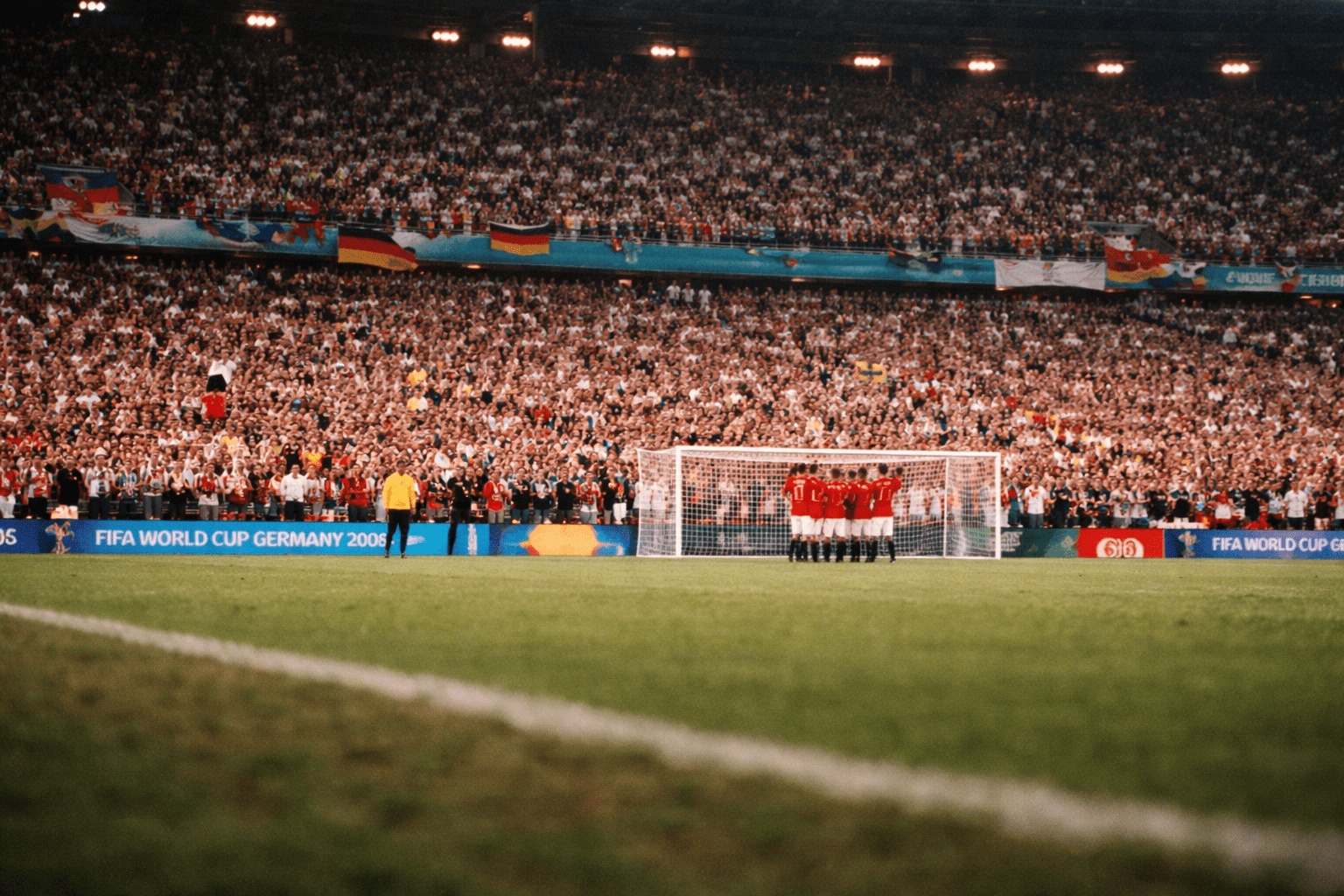
Switzerland were the only team in World Cup history to be knocked out of the tournament without their opponents scoring against them. They kept clean sheets throughout the group stage and then faced Ukraine in the round of sixteen in a goalless draw. The shootout came. Switzerland missed all three of their penalties. They went home unbeaten in open play, unbeaten in the sense that nobody scored past them, and completely out of the competition. It remains one of the strangest exits in World Cup history.
6. The First and Last Goals of the Tournament Were Both Scored by Defenders
German left-back Philipp Lahm scored the opening goal of the tournament against Costa Rica after just five minutes. Italian centre-back Marco Materazzi headed in the final goal of the tournament in the World Cup final itself. No other World Cup has seen both the first and last goals scored by defenders. Materazzi, as it turned out, contributed more goals than almost any other Italian in the squad, scoring twice in the tournament. He also contributed the most talked-about non-goal in the tournament’s history.
7. The Battle of Nuremberg: 16 Yellow Cards and 4 Red Cards in One Match
The round of sixteen match between Portugal and the Netherlands became known simply as the Battle of Nuremberg. Russian referee Valentin Ivanov issued 16 yellow cards and 4 red cards in a single game, setting a World Cup record that still stands. Both teams finished with nine men on the pitch. Portugal won 1-0. FIFA later sent a formal letter to Ivanov questioning his handling of the match. The players were largely blamed for the chaos, but the referee’s willingness to reach for his cards at every opportunity turned a bad-tempered game into a historic one for entirely the wrong reasons.
8. Ronaldo Broke the All-Time World Cup Scoring Record Against Ghana
Brazilian Ronaldo, who had already won two World Cups and was the tournament’s all-time leading scorer heading into Germany 2006, scored his 15th World Cup goal against Ghana in the group stage. The goal broke Gerd Muller’s record of 14 goals, which had stood since 1974. It was one of the few individual highlights of a difficult tournament for Brazil, who were eliminated in the quarter-finals by France. Ronaldo retired from international football shortly after. His record still stands.
9. Miroslav Klose Won the Golden Boot With Just Five Goals
Five goals was enough to win the top scorer award at Germany 2006, the lowest total to claim the Golden Boot since 1962. No other player scored more than three goals in the tournament. It reflected how tightly contested and defensively organised the competition was. Italy, the eventual winners, conceded just two goals across the entire tournament. The 147 goals scored across 64 matches produced an average of 2.3 per game, one of the lower figures in World Cup history. Klose, who would go on to become the World Cup’s all-time leading scorer in 2014, started that journey with a relatively quiet tournament by his own standards.
10. Three Billion People Watched the Final
The 2006 World Cup final between Italy and France drew an estimated cumulative audience of three billion viewers, making it one of the most watched television broadcasts in human history at that point. The entire tournament attracted an estimated 26.29 billion non-unique views across all matches. To put that in context: there were approximately 6.5 billion people on earth in 2006. The planet watched a defender headbutt another defender, a penalty shootout, and a trophy lift that nobody in Italian football was entirely sure their team deserved to celebrate given everything happening at home. They celebrated anyway. So did three billion others.
Written by Explored Football | Fun Facts