Why AC Milan Dominated European Football in the 1990s
The State of Italian Football Before Sacchi
To understand what Arrigo Sacchi achieved at AC Milan, you need to understand what Italian football looked like before he arrived. Serie A in the mid-1980s was a league defined by defensive organisation, catenaccio, man-marking, and the libero — a sweeper who operated behind the defensive line to cover mistakes. Goals were precious, results were everything, and attacking football was considered a luxury that most clubs could not afford.
Milan itself was a club in crisis. In 1980, they had been relegated to Serie B following a match-fixing scandal. They were relegated again in 1982. When media tycoon Silvio Berlusconi bought the club in 1986, he inherited a team that had finished seventh in Serie A the previous season and had not won a league title in nine years. His first major appointment — before Sacchi — was to bring the Dutch trio of Marco van Basten, Ruud Gullit, and Frank Rijkaard to the San Siro. But talent alone was not going to transform the club. For that, he needed a different kind of coach.
Sacchi’s appointment in 1987 caused immediate controversy. He had never played professional football — prompting the famous response when critics raised this: “I never realised that in order to become a jockey you have to have been a horse first.” He had managed Parma in the lower divisions. He was, by the standards of Italian football management, a complete outsider.
Sacchi’s Revolution — What He Actually Changed
The changes Sacchi made were not cosmetic. They were structural — a complete rethinking of how football should be played without the ball.
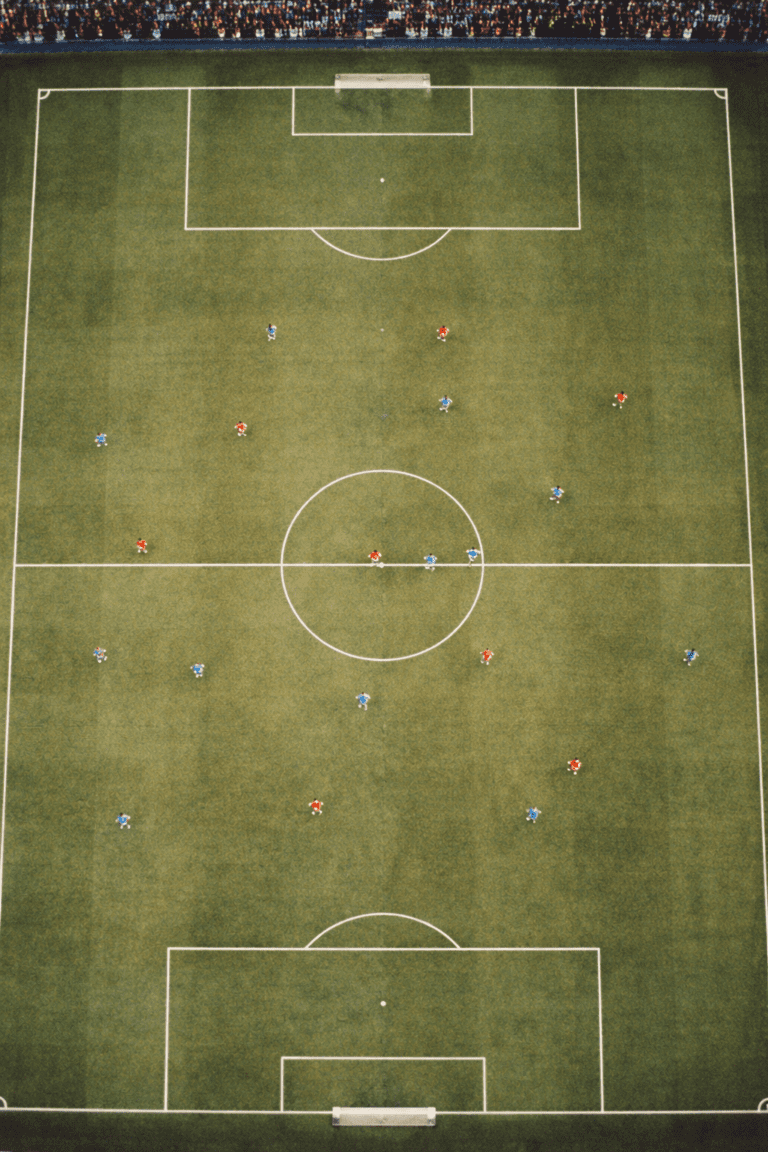
Italian football at the time was built around marking men. Your job was to follow your assigned opponent. Sacchi replaced this with zonal marking — you marked space, not players. The entire team shifted in coordinated blocks toward the ball, narrowing the playing area for the opposition regardless of where individual players moved. The concept sounds straightforward; implementing it against years of ingrained football instinct required an almost obsessive coaching approach.
“Sacchi simply took the ball out of training. For hours and hours, his team in their 4-4-2 would play 11 vs 11 without a football. They were designed to create automatisms — intuitive decisions so ingrained in the players’ minds that the game became a rehearsal of training.”
The story of Juventus sending a spy to Sacchi’s training session before a crucial match in 1988 reveals everything. The spy reported back that Sacchi appeared to be mad — he could not understand what was happening. The players were passing, moving, pressing, and defending without a ball. What Juventus’s spy was witnessing was not madness. It was a new football language being drilled into a team until it became automatic.
The other foundational change was the high defensive line. Sacchi insisted on no more than 25 metres between defence and attack — compressing the pitch, eliminating space for opponents to operate, and enabling the high press by keeping the team compact and close together at all times. This was radical in an era when teams often left enormous gaps between defensive and attacking lines.
The Trophy Record: 1988–1991
1988: Supercoppa Italiana
1989: European Cup — beat Steaua București 4–0 in the final
1989: European Super Cup
1989: Intercontinental Cup
1990: European Cup — beat Benfica 1–0 in the final
1990: European Super Cup
1990: Intercontinental Cup
Milan won every international final they contested under Sacchi — a record of 6 from 6.
The 1989 European Cup final against Steaua București remains one of the most complete performances in the history of the competition. Steaua were not merely a modest opponent — they were the reigning European Cup holders from 1986 and had Romania’s greatest player, Gheorghe Hagi, in their ranks. Milan were 3-0 ahead at half time and added a fourth shortly after the break. Gullit and van Basten scored two goals each. Sacchi had the luxury of substituting Gullit before the hour mark.
A year later, retaining the European Cup — something no team has managed since until Real Madrid’s run from 2016 to 2018 — Milan defeated Benfica 1-0 in a final that was less spectacular but equally controlled. The back-to-back wins confirmed Sacchi’s Milan not as a flash of talent but as a sustainable system.
The Players — How the Pieces Fit Together
The Dutch trio are the names most associated with this Milan side, and rightly so. But understanding why the team worked requires looking at all its components — because Sacchi’s system demanded contribution from every player, and it would have collapsed without the defenders being as good as the attackers.
The Ballon d’Or Dominance — A Statistical Rarity
| Year | Winner | 2nd Place | 3rd Place |
|---|---|---|---|
| 1988 | Van Basten (Milan) | Gullit (Milan) | Rijkaard (Milan) |
| 1989 | Van Basten (Milan) | Baresi (Milan) | Rijkaard (Milan) |
| 1992 | Van Basten (Milan) | — | — |
In 1988, three of the top three Ballon d’Or positions were held by Milan players — an unprecedented achievement that has never been repeated. In 1989, two of the top three were again from Milan. This was not a coincidence of talent. It was a reflection of how completely the system elevated the players within it — and how completely those players expressed the system.
The Transition: Capello Takes Over
When Sacchi left in 1991 — burnt out by the relentless demands of his own system — Fabio Capello took charge. The transition was not expected to work. Capello had no real management experience. He was seen, initially, as a Berlusconi appointment rather than a football one.
What Capello understood, crucially, was that he did not need to dismantle what Sacchi had built. He needed to sustain it with less intensity and more pragmatism. Where Sacchi was a visionary — a hedgehog with one transformative idea — Capello was an adapter, a fox who could apply Sacchi’s principles while managing the physical and psychological demands on players more carefully.
The result was arguably even more statistically dominant domestically, even if less romantically compelling.
1992–93: Serie A title
1993–94: Serie A title — conceded only 15 goals all season
58-match unbeaten run in Serie A (May 1991 – March 1993)
1993–94: Champions League — beat Barcelona 4–0 in the final
Three consecutive Champions League final appearances (1993, 1994, 1995)
The 1993/94 season: Serie A title won by three points over Juventus, only 15 goals conceded, Champions League won 4–0 in the final. Arguably the greatest single season in the club’s history.
The 1994 Champions League Final — The Defining Moment
The 1994 Champions League final against Barcelona deserves extended analysis because of what made it so improbable.
Barcelona under Johan Cruyff had won La Liga four consecutive times (1991, 1992, 1993, 1994) and the European Cup in 1992. Their squad included Hristo Stoichkov — FIFA World Player of the Year — Romario, Ronald Koeman, and a young Pep Guardiola controlling midfield. Cruyff was publicly dismissive before the match, suggesting Barcelona simply needed to show up. His players followed his lead in the press.
Milan went into the final with three key players unavailable. Van Basten was out injured. Baresi and Costacurta were suspended. Due to UEFA’s three-foreigners rule at the time, Jean-Pierre Papin, Brian Laudrup, and Florin Raducioiu could not be included in the squad.
Capello’s tactical response was to move central defender Marcel Desailly into central midfield — specifically to physically dominate Guardiola, who was Cruyff’s tempo-setter in the holding role. The instruction was blunt: Desailly would bully Guardiola out of the game. He did exactly that.
“Every time we read the papers and watched on television what Cruyff and the Barcelona players were saying, we just became more and more determined.” — Daniele Massaro, Milan forward, 1994
The final ended 4-0. Massaro scored twice in the first half. Desailly added a third. Savicevic — who had been omitted from the squad for the previous year’s final against Marseille — scored a fourth with a lob that many consider one of the finest individual goals in Champions League history. Cruyff resigned from Barcelona within two years. He later described it as the most painful defeat of his coaching career.
The AC Milan fans voted the 1994 final the “Match of the Century” in a centenary referendum. It is not hard to understand why. Playing without their three best players, against the most complete club side of the era, in circumstances that invited catastrophe, Milan produced the most dominant performance in a Champions League final since the competition began.
Why the Dynasty Ended
The Milan dynasty did not collapse — it dissolved. The 58-match unbeaten league run ended in March 1993. Van Basten’s career effectively ended with injury in 1993 at the age of 28. Gullit and Rijkaard departed. The UEFA foreigners rule — which limited clubs to three non-nationals — constrained the squad’s flexibility in Europe precisely when replacements for the ageing Dutch trio were most needed.
By 1995, Capello had left for Real Madrid. The players who had been forged under Sacchi — Maldini, Baresi, Costacurta, Donadoni — were ageing. The next generation of European dominance would come from different clubs: Juventus in the mid-1990s, then Real Madrid and Manchester United at the turn of the century.
What Milan left behind was not just trophies. They left a complete re-education of how European football thought about defensive organisation, pressing, and the relationship between tactical system and individual talent. Every manager who talks about compactness, zonal marking, or the high press is, knowingly or not, speaking the language Sacchi invented in a training field in Milan in 1987.
The Legacy in Numbers
| Metric | Achievement |
|---|---|
| European Cups won (1988–1994) | 3 (1989, 1990, 1994) |
| Serie A titles (1988–1994) | 4 (1988, 1992, 1993, 1994) |
| International finals record | Won all 6 under Sacchi |
| Longest unbeaten league run | 58 matches (1991–1993) |
| Goals conceded (1993/94 Serie A) | 15 in 34 matches |
| 1994 CL final scoreline | 4–0 vs Barcelona |
| Ballon d’Or top 3 from one club | 1988 and 1989 |
| Voted best club side of all time | World Soccer magazine global poll |
What Made This Milan Side Different From Every Other Dynasty
Most football dynasties are built on talent — clubs that assemble the best players and allow them to express themselves. Milan under Sacchi was built on an idea — a specific, radical, precisely articulated vision of how football should be played — and then assembled the talent to execute it.
The paradox at the heart of this Milan side is that the most talented players in their squad — van Basten, Gullit, Rijkaard — were also the ones most completely subordinated to the system. There were no individuals exempt from defensive work, no players allowed to freelance outside their tactical responsibilities. The extraordinary thing is that players of that calibre accepted those constraints — and that those constraints made them better rather than limiting them.
Sacchi once said that his fundamental principle was that football was not about the ball, but about space. That principle — articulated in the late 1980s at a club that had been in Serie B six years earlier — became the foundational text of modern European football. Every pressing team, every high defensive line, every coach who talks about controlling space rather than tracking opponents, is working from the same source material.
The trophies confirmed the dominance. The ideas outlasted the trophies.